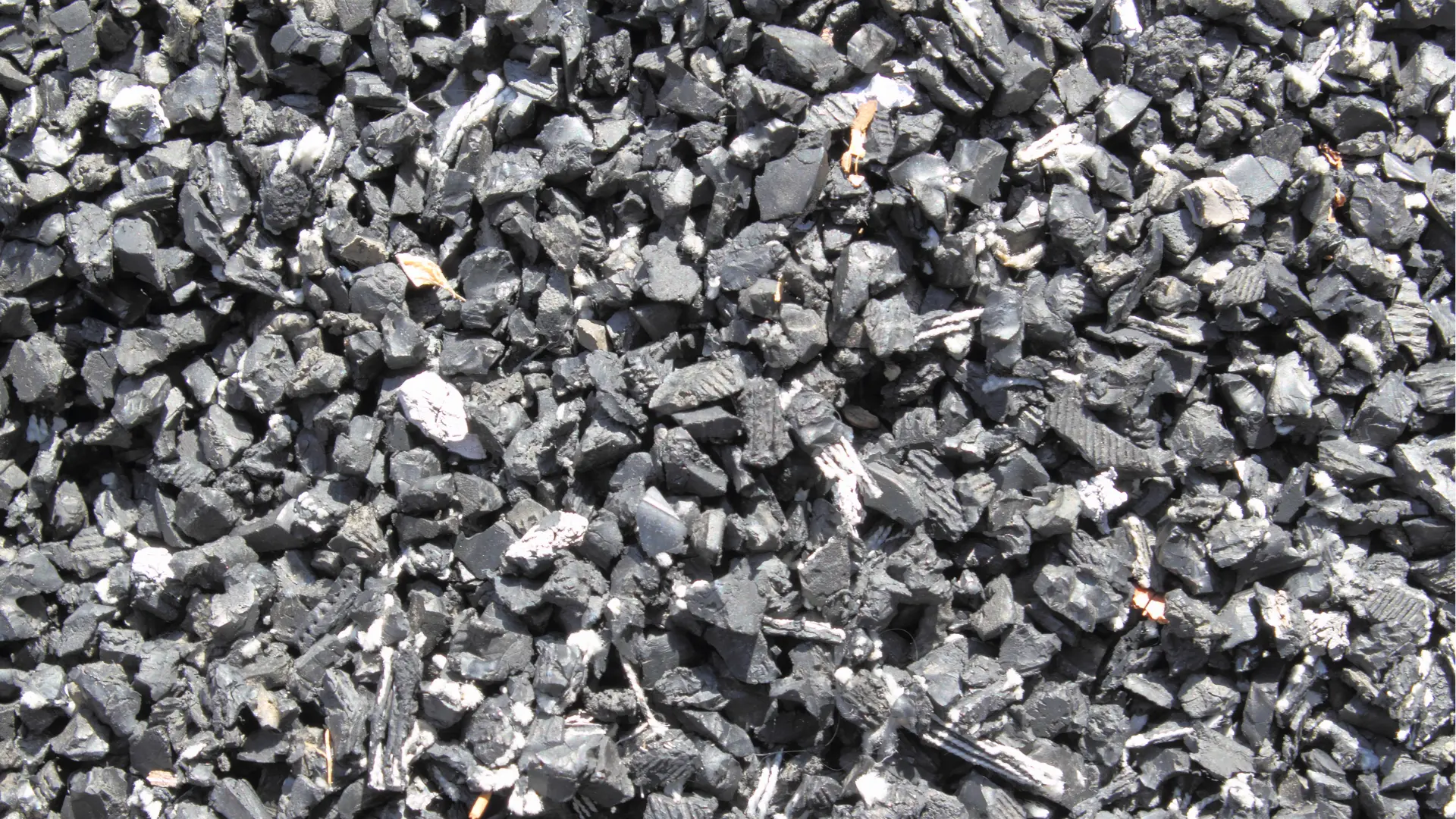
What is rubber mulch?
Rubber mulch is made from recycled tires - they shred them into small pieces that look like mulch. You'll usually see it in:
- Black (most common)
- Brown, red, or other colors (less common, usually coated)
Where people use it:
- Playgrounds
- Dog runs
- Landscaping where you want something that lasts forever
It doesn't break down like wood or turn into soil. Think of it more as permanent playground surfacing than actual mulch.
What are wood chips?
Wood chips are chipped up branches and wood waste used as natural ground cover. For playgrounds specifically, you'll see names like:
- "Playground wood chips"
- "Playground mulch"
- "Engineered wood fiber" - more processed version used in public playgrounds
Common uses:
- Playgrounds
- Paths and trails
- Garden beds (depending on size)
- Erosion control
Wood chips are organic, so they break down over time. In wet climates they break down faster. You'll need to top them off periodically, that's just part of the deal.
Safety & cushioning (the playground question)
This is usually the deciding category.
1) Impact absorption (cushioning)
Both rubber mulch and wood chips can provide impact absorption, but performance depends heavily on:
- Depth of material
- Compaction over time
- Whether it stays evenly spread
- Drainage and moisture
Wood chips: cushioning depends on depth and condition
Fresh wood chips can be springy and forgiving. Over time, they:
- Compact
- Get displaced
- Break down into smaller particles
That means cushioning can degrade unless you rake and top up.
Rubber mulch: cushioning can be more consistent
Rubber mulch doesn't break down like wood chips, so its physical size remains stable longer. It can provide consistent cushioning if:
- Installed at proper depth
- Maintained so it doesn't migrate
- The base/drainage is solid
But note: rubber pieces can scatter, especially with active play.
2) Traction and play behavior
- Wood chips tend to "lock" together a bit more and feel natural underfoot.
- Rubber mulch can feel springy but may shift more easily depending on piece shape and depth.
3) Splinters vs "foreign objects"
- Wood chips: can splinter, though playground-grade products are often processed to reduce sharp edges.
- Rubber mulch: no splinters, but pieces can end up in shoes, pockets, and sometimes indoors.
Both can hide small objects if not maintained-so routine inspection matters regardless.
Longevity & maintenance: what you'll be dealing with
Rubber mulch maintenance
Rubber mulch is often marketed as "low maintenance," and it can be, but it's not zero-maintenance.
Common realities:
- Pieces scatter beyond the play area
- You'll occasionally rake it back into place
- Weeds can still grow in it (especially if debris accumulates on top)
- You may need edging/borders to keep it contained
The big advantage: it doesn't rot, doesn't become soil, and doesn't shrink due to decomposition.
Wood chip maintenance
Wood chips are more "natural maintenance."
Common realities:
- You'll rake/re-level them
- You'll top up periodically because they break down
- They can wash or move after heavy rain unless the area is well-contained
- They may need more frequent replacement in wet climates
The benefit: it's easy to add more chips, and the material is widely available.
Environmental considerations (without getting preachy)
This part matters to many people, and it's worth being clear: rubber and wood are fundamentally different materials.
Rubber mulch: durable, but not biodegradable
Rubber mulch is often made from recycled materials (like tires), which is a form of reuse. However:
- It doesn't decompose
- It stays in the environment unless removed
- Over long time horizons, rubber can break into smaller particles through wear
Some people love rubber mulch because it's "recycling." Others avoid it because it's not a natural material and they don't want rubber in their yard. This is a personal choice.
Wood chips: biodegradable and soil-friendly (eventually)
Wood chips break down and become part of the soil ecosystem over time. They:
- Support moisture retention
- Can improve soil structure in the long run
- Are part of a natural cycle
The flip side is: decomposition is exactly why you'll need top-ups.
A practical environmental note
If you want a "natural" playground surface, wood chips (or engineered wood fiber) usually aligns better with that goal.
If you want something long-lasting that doesn't decompose, rubber mulch is more like a long-term surfacing layer.
Cost over time: what's actually cheaper?
This is where people get surprised.
Upfront cost
- Wood chips usually win on upfront cost, especially if bought in bulk. They can be even cheaper if you have access to municipal/free wood chips.
- Rubber mulch often costs more upfront, especially for large play areas and proper depth.
Ongoing costs
- Wood chips: recurring top-ups/replacements
- Rubber mulch: fewer material replacements, but may need occasional replenishment and containment improvements
So the question becomes: Are you optimizing for lowest cost today or lowest cost over 5–10 years?
Typical homeowner pattern
- If you're building a small backyard play area and you don't mind topping up once in a while → wood chips are often the simplest and cheapest.
- If you're installing a dedicated playground area and want long-term consistency with fewer refreshes → rubber mulch can make sense.
Heat and comfort: a real-world factor
In sunny climates, surface temperature matters.
- Dark rubber mulch can get hot in direct sun.
- Wood chips can also heat up, but many people report rubber surfaces feeling hotter.
If your play area is:
- Full sun
- Used barefoot or with lots of sitting/rolling around
then temperature is something to pay attention to.
Shade structures and lighter surface choices can matter more than people expect.
Drainage: how each behaves in rain
Both rubber mulch and wood chips can work with good drainage, but:
- Wood chips can absorb moisture and break down faster in consistently wet areas.
- Rubber mulch doesn't absorb water the same way, but it can still trap moisture underneath if the base is poorly designed.
The real key is base prep:
- Stable, well-draining underlayer
- Borders/edging to prevent washout
- Enough depth maintained over time
Bad drainage ruins both options.
Which is better for playground mulch?
Let's map it to common scenarios.
Choose wood chips (playground mulch) if:
- You want a natural material
- You can top up occasionally
- You want lower upfront cost
- You have access to bulk chips locally
- You're okay with some mess migration (chips in shoes)
Wood chips are the default answer for many homeowners because they're easy to source and easy to refresh.
Choose rubber mulch if:
- You want long-term durability
- You want fewer decomposing/shrinking issues
- You're building a more permanent play zone
- You're willing to invest upfront
- You can contain it properly with edging
Rubber mulch is often chosen when the priority is long-term consistency and reduced refresh work.
What to ask suppliers before you buy
Whether you choose rubber mulch or wood chips, ask suppliers:
If buying wood chips / playground mulch
- Is this labeled for playground use (if applicable)?
- What's the recommended depth?
- Is it chipped, shredded, or engineered wood fiber?
- Can I buy it in bulk by the yard?
- Do you deliver, and what's the minimum order?
If buying rubber mulch
- Is it made from recycled rubber, and is it coated/colored?
- What depth do you recommend for my use?
- Does it come with edging or containment recommendations?
- Do you offer delivery and installation?
- How much does it weigh/cover per unit?
How MulchMap helps you find playground mulch suppliers near you
If you search "rubber mulch near me" or "playground mulch," you'll often see:
- Big-box stores with bagged options
- Local landscape supply yards
- Specialty playground surfacing suppliers
- Sometimes garden centers and nurseries
The problem is that not every listing makes it obvious what they carry.
MulchMap's advantage is that it's organized by location, and it uses listing text/reviews to identify product types. That means you can:
- Filter for rubber mulch suppliers
- Filter for wood chips / playground mulch suppliers
- Compare delivery vs pickup availability
- Shortlist suppliers that match your project size (bulk vs bagged)
Final takeaway
Rubber mulch vs wood chips isn't about "which is objectively better." It's about what kind of trade-off you want:
- Wood chips: natural, cheaper upfront, easy to refresh, requires periodic maintenance
- Rubber mulch: durable, less decomposition, higher upfront cost, needs good containment, not a natural material
If you want the simplest backyard solution and don't mind occasional top-ups, wood chips are hard to beat. If you want a more permanent "install it once" feel and you're okay paying more upfront, rubber mulch can make sense.